
Rethinking a website can make you want to start all over from scratch: a blank page, a new identity, a fresh start. But before rethinking everything, there's a step that many people jump over too quickly: honestly assessing what you already have.
Because your current website, even if imperfect, contains a treasure trove of valuable information. It tells you what resonates with your visitors, what drives them away, and what goes completely unnoticed.
And while you're analyzing your site, it's just as helpful to take a look around you. Not to copy your competitors, but to understand what your market is really looking for and, most importantly, to identify untapped opportunities.
In this article, we guide you through two essential steps for a successful redesign: assessing what your current site has to teach you, and intelligently analyzing the competition to stand out with purpose.
Evaluate your current content
If you already have a website, start by analyzing what works and what needs improvement. This step requires some perspective and, sometimes, a good dose of honesty, but it will help you avoid repeating the same mistakes on your new site.
Where can you find your data?
Before analyzing anything, you need data. If you don't already have an analytics tool installed on your site, now is the time to do so. Google Analytics or Matomo (a more privacy-friendly alternative) will give you access to a wealth of information about your visitors' behaviour. If your site has been around for a while, you probably already have data to work with; it's just a matter of knowing where to look.

Your current performance
Start with the numbers. They often tell a story that intuition doesn't see:
What are your most visited pages? These pages are your most valuable assets. Make sure they accurately reflect your current priorities, are up to date, and clearly guide the visitor to the next step.
Which pages generate the most conversions? A conversion is a desired action: filling out a contact form, subscribing to your newsletter, or scheduling an appointment. If some pages convert better than others, ask yourself why. What are they doing differently?
Where do visitors most often leave your site? These high-bounce-rate pages deserve special attention. Does the content truly address what the visitor was looking for? Is the page difficult to read or navigate? Is the call to action clear?
Which pages are rarely or not at all visited? Content that no one reads isn't necessarily bad — it may simply be poorly positioned in your navigation, or it may address a question your visitors are not yet asking. It's up to you to decide: highlight it, rework it, or remove it.
How many pages does each visitor view on average, and how long do they stay on your site? These indicators give you a general idea of engagement. A visitor who views multiple pages and stays for a long time is someone who finds value in your content.
The quality and accessibility of your content
Numbers don't tell the whole story. You also need to read your texts with a fresh perspective, or better yet, have someone who doesn't know your business read them.
Are your texts still up to date and accurately reflect your current offerings? Do they answer your visitors' real questions, or do they mainly talk about you? Are they pleasant to read, well-structured, and easy to browse? If your site is multilingual, does each page contain the same updated information in every language?
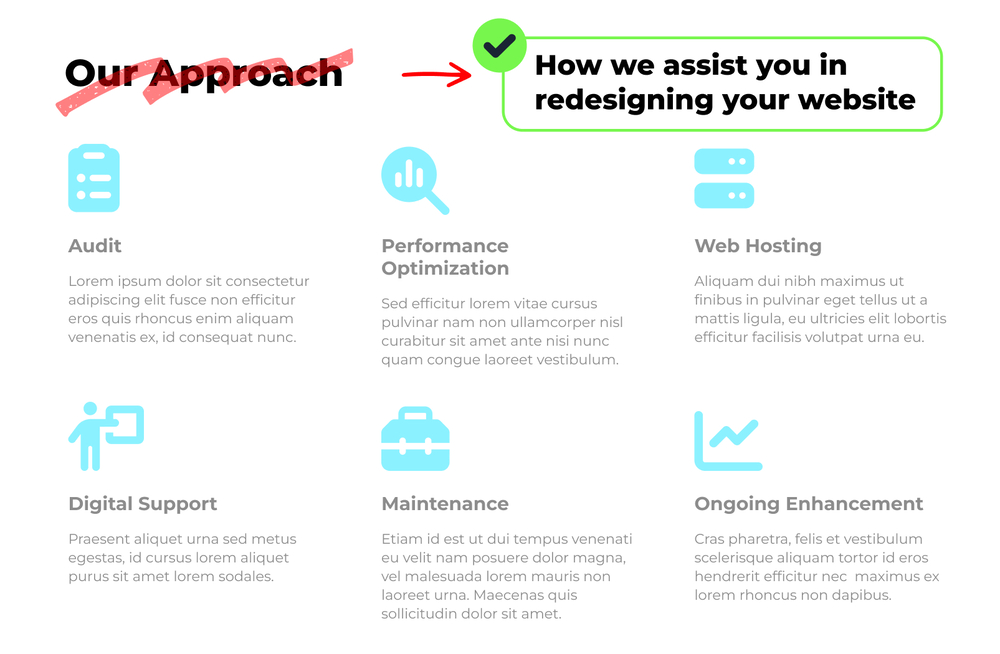
Accessibility also starts with your texts. Your headings should be clear and descriptive. A heading like 'Our Approach' doesn't say much. 'How we assist you in redesigning your website' is much more meaningful for your visitors.
Good web content isn't necessarily long. It is clear, useful, and organized so that the reader can quickly find what they're looking for.
Intelligently analyze your competitors
Competitive analysis is not about copying, but about understanding your market's expectations and identifying opportunities to stand out. It's an exercise that requires curiosity and a strategic perspective, without necessarily taking up much of your time.
Where to start?
Choose 3 to 5 direct competitors — organizations offering similar services to yours and targeting the same type of clientele. Visit their website as if you were a potential customer: assess your first impression, identify the elements that catch your attention, those that cause confusion, and finally, those that might encourage you to leave the site.
Next, ask yourself these questions for each of them:
How do they structure their information? Is the navigation intuitive? Are the services easy to find? Can you quickly understand what they do and for whom? A clear structure often reflects an organization that knows its clients well.
What topics do they cover in their content? If your competitors have a blog or publish resources, look at the themes they address. But also pay attention to the topics they neglect; often, that's where your best opportunities to stand out are.
How do they present their services? Do they emphasize features or customer benefits? Do they use case studies, testimonials, or concrete examples? These editorial choices say a lot about how they attract their clients.
What gaps can you fill? This is the most strategic question. After analyzing several sites, you'll start to notice bad habits: unanswered questions, unmet needs, angles that no one has yet addressed. This is where your opportunity to stand out with authenticity lies.
What you are really looking for
This exercise is not about copying what your competitors are doing, but about better understanding market expectations in order to identify where you can offer something more, different, or more human. Your competitive analysis should always end with this question: what can we offer that no one else has yet?
Next step: Create a logical content structure
Conducting an audit of your current site and analyzing the competition are essential steps to successfully revamp your project. An effective site isn't necessarily the most beautiful or modern, but the one that provides the right answers, at the right time, for the right people.
By taking the time to honestly assess what you already have and what your market is looking for, you give yourself the means to build something stronger and better aligned with your true objectives.
Now that you clearly understand your objectives, your audience, your current digital situation, and your competitors', it's time to think about the next step: how to structure all this content in a coherent and intuitive way for your visitors.
This is exactly what we explore in the next article: Creating a Logical Content Structure.